
Accelerating Game Development: How AI-Generated 3D Assets Are Saving Indie Devs Time and Money
 Edward Anatoli
Game development is often described as a marathon, but for indie devs, it feels more like a sprint where the finish line keeps moving. You are constantly battling against "scope creep." If you are a solo developer or part of a tiny studio, you know the struggle intimately: your vision is expansive, limitless, and colorful, but your resources—time, budget, and manpower—are strictly finite.
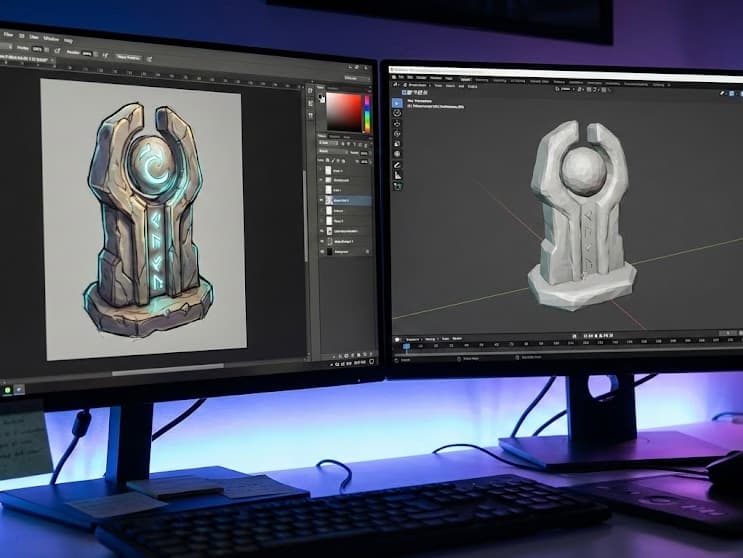
For years, the most significant bottleneck in the pipeline—the thing that kills projects before they launch—has been 3D asset creation. To make a world feel immersive, you can't just have a hero and a floor. You need hundreds of props, environmental assets, debris, and clutter. Traditionally, filling a scene meant months of manual modeling or burning thousands of dollars on freelancers.
But the industry workflow is shifting. AI Image-to-3D technology is emerging not just as a novelty, but as a practical production tool. It is changing how we approach the "asset grind," turning 2D concepts into 3D reality in seconds.
Here is how ai3dgen.com is democratizing game design and, more importantly, a realistic look at how to integrate AI-generated STL assets into a professional pipeline.
The Bottleneck: Why 3D Production Kills Indie Budgets
To understand the value of AI, we have to look at the traditional cost of a single asset. Let's be real: creating high-quality 3D props is a massive time sink. Even a simple object—say, a stylized treasure chest or a sci-fi crate—follows a rigid, time-consuming pipeline:
- Concept & Reference: Gathering visual data.
- Blocking: Establishing the silhouette.
- Modeling/Sculpting: Creating the complex geometry.
- Retopology: Cleaning up the mesh for game engines.
For a solo developer, modeling a single detailed tavern scene can take weeks. This creates a dangerous trade-off: do you spend your precious hours modeling chairs, or do you spend them coding the actual gameplay mechanics that make your game fun?
This is where the "Asset Store Trap" usually happens. Developers buy generic asset packs to save time, but these packs rarely match each other. One looks realistic, the other looks cartoonish, and suddenly your game lacks a cohesive visual identity.
The Solution: AI as Your "Geometry Generator"
ai3dgen.com is designed to smash this bottleneck by focusing on the most fundamental part of 3D creation: the Geometry.
The technology interprets visual data from a 2D image (a sketch, photo, or concept art) and predicts depth, form, and volume to generate a 3D mesh. Within moments, you have a solid STL file ready for download.
Why focus on STL? Because it is the universal language of raw geometry. While other formats get bogged down in complex texture dependencies or rigging data that might break across different software, STL is pure, unadulterated shape. It is lightweight, compatible with virtually every 3D software (Blender, ZBrush, Maya, CAD), and is the gold standard for rapid iteration.
It isn't about replacing the artist; it is about automating the blocking phase so you can focus on the details.
3 Strategic Ways to Use AI STL Assets
As developers ourselves, we know that fitting a new tool into your workflow takes thought. Here is how smart studios are using ai3dgen.com to move faster:
1. Rapid Prototyping (Beyond Greyboxing)
Greyboxing (using cubes to test levels) is functional but uninspiring. It’s hard to judge the "vibe" of a horror game or a fantasy ruin when you are looking at white capsules and cubes.
- The Workflow: Sketch a spooky statue, a jagged rock formation, or a gothic pillar. Upload it to ai3dgen.com.
- The Result: In minutes, you have a solid STL mesh to drop into your level. It conveys the silhouette and mood instantly. This allows you to test sightlines, collision, and scale with assets that actually look like your final vision, keeping your team motivated.
2. The "Digital Clay" Workflow (For Sculptors)
Starting from a blank sphere in ZBrush or Blender can be daunting, even for pros. This is where our STL files shine as a "Base Mesh."
- The Workflow: Don't waste time modeling the basic shape of a dragon head or a futuristic helmet. Generate the STL from a reference image, import it into your sculpting software, and use it as your "digital clay."
- The Benefit: The AI handles the volume and proportion. You simply smooth it out and add the high-frequency details. You’ve just skipped the first 2 hours of blocking out the shape, jumping straight to the fun part of detailing.
3. Physical Merch and Board Games
Because ai3dgen.com specializes in STL generation, our output isn't just for video games—it's ready for the physical world.
- The Opportunity: Indie devs are increasingly funding their games through Kickstarters that include physical miniatures. Our STLs are 3D-printing friendly. You can turn your in-game assets into physical board game pieces or collectibles for your fans without needing a separate CAD engineer.
Real Talk: Managing Expectations (Trust & Transparency)
At ai3dgen.com, we believe in being upfront with our community. AI 3D generation is a powerful accelerator, but it's important to understand the role of the STL format.
- Best Use Cases: Hard-surface objects, environmental props (rocks, trees, ruins), static meshes, and sculpting bases.
- The "Raw Geometry" Mindset: Remember that an STL file is raw geometry. It does not contain UV maps or skeletal rigs. Think of our tool as a digital kiln that fires out the solid shape of your idea.
- The Workflow: You get the shape from us $\rightarrow$ You auto-unwrap or texture it in your preferred software (like Blender or Substance Painter).
Think of AI not as a "Make Game" button, but as a junior modeler that works at lightning speed. It gets you 80-90% of the way there, handling the heavy lifting of form and volume, allowing you to cross the finish line faster.
Conclusion: Adapting to the New Pipeline
The future of indie game development isn't about working harder; it's about optimizing where you spend your creative energy. The "grind" of modeling every single background rock is a thing of the past.
By automating the creation of environmental assets and base meshes with ai3dgen.com, you reclaim the most valuable resource you have: your time. The developers who adapt to these workflows will be the ones who ship their games while others are still stuck tweaking vertices on a background barrel.
Ready to speed up your pipeline? Stop staring at a blank viewport. Take a sketch, turn it into a high-quality STL, and see how much time you can save on your next sprint.