
From 2D Stock Photos to 3D Printable Products: The Arbitrage Opportunity Nobody Is Talking About (And How Figurines Fit In)
 Edward Anatoli
TL;DR: The same image that sells for $0.25 as a 2D stock photo can be transformed into a $15–$60 3D printable product. This "dimension arbitrage" is creating a new class of solo creators who are building real revenue streams in figurines, desk accessories, and custom collectibles—without touching CAD software or outsourcing to modeling studios.
The Arbitrage Gap Nobody Is Measuring
In 2024, the global 3D printing market crossed $20 billion. Meanwhile, the stock photo industry is shrinking under the weight of AI-generated 2D imagery. But here is the counterintuitive part: the same visual content that is commoditized in 2D is becoming more valuable in 3D.
A high-quality 2D illustration on a stock platform might earn a creator $0.25 per download. That exact same character design, converted into a watertight, printable 3D mesh, sells on Etsy, CGTrader, or Patreon for $8–$25 per file. Physical prints of that model? $35–$120.
This is not a theory. It is a measurable arbitrage gap between flat content and dimensional content. And the tool stack to exploit it is now accessible to anyone with a browser.
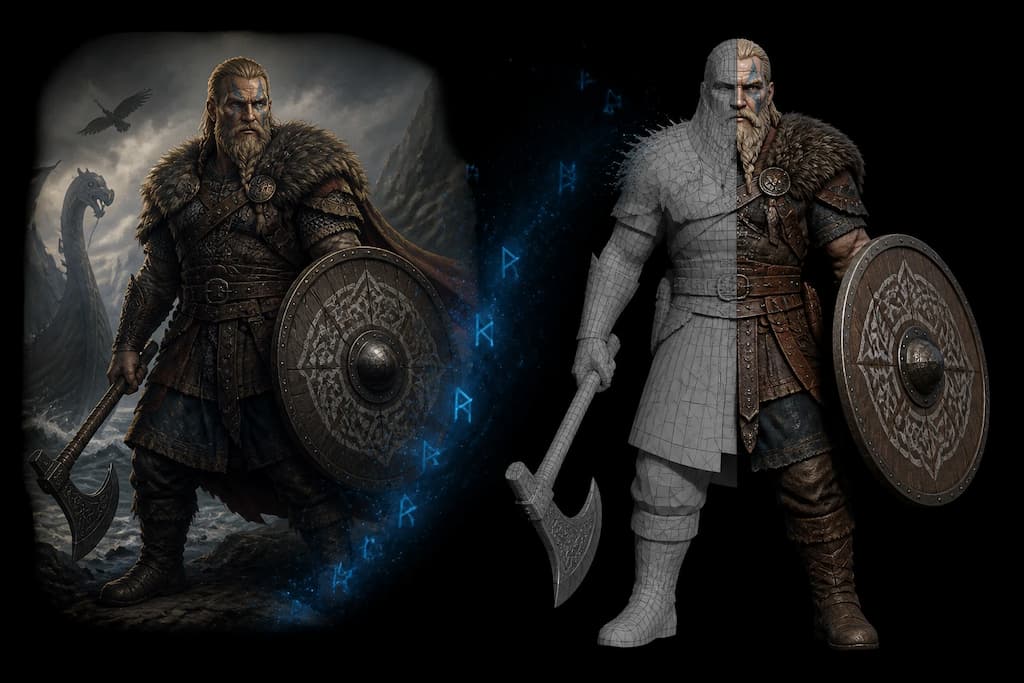
Why Figurines and Collectibles Are the Perfect Entry Point
If you want to understand where this arbitrage is most profitable, look at figurines and character collectibles.
The global action figure and collectible market is projected to exceed $20 billion by 2028. But the supply chain is rigid: traditional PVC figurines require $10,000+ mold costs, 6-month lead times, and minimum order quantities of 1,000+ units. This locks out independent artists, niche fandoms, and micro-designers.
AI 3D generation changes the economics entirely. A solo creator can now take a 2D character concept—original art, a commissioned illustration, or even a carefully licensed reference—and generate a printable 3D figurine mesh in under an hour. The upfront cost drops from five figures to the price of a coffee subscription.
The buyers are already there:
- Tabletop gamers want custom miniatures that no factory mold can justify.
- Anime and pop-culture fandoms pay premiums for limited-run garage-kit-style figurines.
- Gift buyers on Etsy search for "personalized 3D printed figurine" and "custom desk companion" daily.
The demand is fragmented, emotional, and high-margin. Exactly the kind of market that AI-enabled solo creators can dominate.
The Workflow: From Image to Sellable 3D Print
The arbitrage only works if the workflow is reliable. Here is the current stack that creators are quietly using to go from concept to revenue in a single day.
Step 1: Source or Create the 2D Concept
The input can be original illustration, AI-generated concept art, or a licensed reference image. The key constraint is not artistic skill—it is clarity. A clean front-facing character with visible silhouette and proportion details will produce a better 3D output than a busy, atmospheric painting.
Many creators clean up silhouettes, adjust proportions, or isolate the subject before feeding it into the 3D pipeline. Removing distracting backgrounds is often the difference between a usable mesh and a noisy failure.
Step 2: Convert 2D to 3D
This is where the arbitrage happens. Modern AI 3D model generators from images can infer depth, volume, and surface structure from a single photograph or illustration. The output is a textured mesh—often in OBJ, GLB, or STL format.
For creators who are testing the market, a free image to 3D model converter is enough to validate demand. You can generate a low-poly proof-of-concept, list it as a "beta" digital download, and gauge buyer interest before investing in refinement.
For sellable figurines, the mesh usually needs to pass through a higher-quality pipeline that produces cleaner topology, watertight geometry, and proper wall thickness. This is non-negotiable for FDM and resin printing.
Step 3: Post-Process for Printability
AI-generated 3D models are not always print-ready out of the box. The typical fixes are:
- Hollowing: Solid figurines waste resin and increase print time. A hollow shell with drainage holes is standard.
- Support structures: Overhangs on arms, hair, or capes need to be printable at 45-degree angles or supported.
- Base attachment: A figurine without a flat base will fail on 90% of consumer printers. Adding a keyed base is a 30-second fix that doubles print success rates.
Tools like Blender, Meshmixer, or even browser-based repair services handle this in 10–20 minutes per model.
Step 4: List, Price, and Sell
The final asset is sold in two forms:
- Digital file: STL/OBJ on Etsy, Gumroad, or Patreon. Typical price: $8–$25.
- Physical print: The creator prints on a $200–$500 consumer resin printer, ships the finished figurine. Typical price: $35–$120.
The digital file has zero marginal cost. The physical print has material costs of $2–$8 and shipping of $5–$12. Margins on both are 60–85%.
Real-World Case Studies
Case 1: The Niche Miniature Designer
A creator in the tabletop RPG space took 12 original character illustrations and generated printable 28mm miniatures using an ultra high quality 3D model generator. The models were listed on Etsy as "AI-assisted custom miniatures" at $18 per set of 4.
First-month revenue: $340. Second month: $890. The creator now commissions original 2D art specifically for 3D conversion, creating a repeatable content pipeline.
Case 2: The Pop-Culture Garage Kit Seller
A seller in Japan used AI 3D generation to produce stylized figurines of public-domain characters (classic literature, mythology) and sold them as "digital garage kits" on Booth.pm. Buyers print at home on Elegoo Saturn printers.
The seller's competitive advantage was speed. A traditional garage-kit sculptor takes 2–3 months per prototype. The AI-assisted workflow produced 3 new designs per week. The shop now has 80+ SKUs and a 4.9-star rating.
Case 3: The Corporate Gift Micro-Business
A U.S.-based creator used AI 3D generation to turn employee photos into stylized desk figurines. The service was marketed to HR departments as "3D-printed team mascots." Average order: 12 figurines at $45 each. The 3D generation step took 20 minutes per person; the printing and shipping was outsourced to a local print farm.
This is the B2B version of the arbitrage: higher ticket, lower volume, but significantly more defensible than competing on Etsy for generic dragon figurines.
The Technical Bottleneck (And How to Solve It)
The arbitrage is real, but it is not frictionless. The three most common failure points for creators are:
1. Non-Manifold Geometry
AI-generated meshes often have internal faces, holes, or self-intersections. A slicer (Cura, PrusaSlicer, Chitubox) will reject these. The fix is automated repair software or manual cleanup in Blender. The creators who build systematic repair workflows scale faster than those who manually fix every file.
2. Scale and Proportion
A figurine generated from a 2D anime illustration may have paper-thin limbs or hair strands that are 0.2mm wide—impossible to print on an FDM printer and fragile on resin. The solution is not better prompting; it is a post-processing step where the creator thickens fragile geometry and adds a keyed base.
3. Texture vs. Geometry
Some AI 3D generators produce beautiful textures on low-poly geometry. For 3D printing, this is useless—printers read geometry, not texture maps. Creators need to understand when to use a quick prototyping setup versus a production-ready, high-geometry output.
If you are unsure how to navigate this pipeline, a detailed guide on how to turn a picture into a 3D printable model can save hours of trial and error.
Pricing Psychology: Why Buyers Pay 60x More for 3D
The most important question is not can you sell AI-generated 3D models. It is why buyers pay 60x more for a 3D file than a 2D image of the same subject.
The answer is utility and ownership.
A 2D image is consumed passively. It lives on a screen. A 3D printable file is a tool. The buyer can hold it, paint it, gift it, or modify it. The ownership experience is tactile and permanent. This is why a $0.25 stock photo and a $15 STL file can depict the exact same character and still command wildly different prices.
For figurines specifically, the emotional multiplier is even higher. A buyer is not purchasing geometry. They are purchasing a physical manifestation of a character they love. The 3D file is just the delivery mechanism for that emotion.
Legal and Platform Considerations
No arbitrage strategy is complete without addressing the risk side.
Copyright and Originality
You cannot take a copyrighted character (e.g., a Marvel superhero, a Pokémon) and sell the 3D model without a license. The safest path is:
- Original characters: You own the 2D art and the 3D derivative. Full commercial rights.
- Public domain: Mythology, historical figures, and classical literature are fair game.
- Licensed 2D art: Commission an artist, secure commercial rights, then generate the 3D model.
- Transformative fan art: This is a gray area. Some platforms tolerate it; others do not. Etsy, in particular, has aggressive IP takedown systems.
Platform Policies
- Etsy: Allows digital 3D files. Prohibits unlicensed IP. AI-generated content is allowed if disclosed.
- CGTrader / TurboSquid: Focus on professional buyers. Require clean topology and accurate scale. Higher prices, higher standards.
- Patreon / Gumroad: Subscription or direct-sale models. Best for recurring revenue and community building.
- Booth.pm (Japan): Dominant for figurine culture. Garage-kit and "digital data" sales are well-established.
Disclosure
Transparency is a competitive advantage, not a liability. Sellers who label their products as "AI-assisted design, hand-finished for print" build more trust than those who hide the workflow. Buyers care about print quality and reliability, not the software stack.
The Window Is Open, But Not Forever
Every arbitrage opportunity eventually closes. The 2D-to-3D gap is open right now for three reasons:
- Most creators are still 2D-native. They think in flat images and do not realize their existing portfolio can be dimensionalized.
- 3D printing hardware is now consumer-grade. A $300 resin printer produces results that were impossible on $10,000 machines a decade ago.
- AI 3D generation is crossing the quality threshold. The output is no longer a novelty mesh. It is a sellable product.
But as more creators enter the market, the easy wins will disappear. The sellers who build systematic workflows, brand identity, and customer relationships now will own the niche when the market matures.
If you have a library of 2D art, a reference image collection, or even a single character design you love, the next step is to upload the image to a free 3D model generator and see what the arbitrage looks like from the other side.
The gap between 2D and 3D is not a technical barrier anymore. It is a perception barrier. And perception barriers are where the best businesses are built.